

Inbound calls are phone calls from customers who need a service, this includes electricians, HVAC technicians, and plumbers. Such calls are valuable for home service providers. Most of these callers need urgent help and want to book instantly, making inbound calls more likely to turn into paying jobs. Digital marketing plays a huge role in generating such calls because most customers search online before choosing a service provider. Google Ads is a powerful tool for home service providers to efficiently and instantly generate inbound calls. Google Ads help companies to appear at the of search results and connects home service providers with high-intent callers directly. Such results can be acquired with the right strategy.
Why Are Inbound Calls Vital for Home Service Providers?
Inbound calls are important for home service providers because they connect you quickly with customers who need urgent help and are usually ready to book a service when someone calls. This results in higher conversion rates compared to emails or forms. Phone conversations build faster since this method allows customers to speak to you to answer questions and provide personalized solutions.
For more insights on advertising, see “Top 3 Advertising Channels for Home Service Businesses“.
How Google Ads Drive High-Intent Inbound Calls?
Google Ads allow home service companies to position their business in front of customers at the exact moment when they are searching for help on the web. It primarily operates on the PPC (pay-per-click) model, which means that advertisers pay when a user clicks their ad. Google Ads sits at the core of call generation strategies whether managed via a third-party or an accredited lead provider. This system can be structured to prioritize inbound calls over website visits for companies that focus on phone calls.
Understanding the PPC Foundation
Google Ads is an auction-based advertising platform at its core, which allows companies to bid on keywords that are related to their services, and ads show up when customers search those terms. You are charged when a customer clicks the ad. It does not charge when it only appears. Campaigns can be optimized to generate calls as the main conversion action even though Google Ads is not technically pay-per-call. Most lead generation companies use this PPC system behind the scenes before reselling calls on a pay-per-call or pay-per-lead basis. Below are the reasons that state why PPC works for call generation methods:
- Providers real-time optimization based on performance data.
- Allows budget control at everyday and campaign levels.
- Provides measurable cost per call and cost per click.
- Targets customers actively who are looking for specific services.
Search Ads for Intent-Powered Visibility
Search Ads are text-based ads that show up at the top of Google results when customers type service-related terms or queries. Since such searches show urgency, they have more chances of becoming phone calls instantly. Home service companies can capture ready-to-book customers by geographic modifiers with high-intent phrases and keywords.
What Strengthens Search Ad Performance?
Search ads are the starting point for inbound calls strategies because they align with direct customer demand closely.
- Mobile-optimized ad formats for one-tap dialing.
- Clear CTA (Call-to-Action) buttons.
- Headlines emphasizing guarantees, availability, and speed.
- Local targeted combined with service-specific keywords.
Call-Focused Campaign Structures
Google Ads provide campaign formats designed to reduce friction between call and search for companies that prioritize phone leads, allowing call-focused structures to encourage direct engagement and remove unnecessary steps. Such campaigns are effective for industries where urgency drives decisions, like appliance breakdowns, electrical services, plumbing, and HVAC repair.
Call-Only Ads
Call-Only Ads are made to encourage instant phone calls and mobile users. The main action is initiating a call instead of directing users to a landing page. This system attracts users who want to speak with a service provider and filters out casual browsers. The click action triggers a phone call interface directly while advertisers pay for clicks. Best use cases are:
- Markets with solid mobile search behavior.
- High-margin service requiring consultation.
- 24*7 operations.
- Emergency repair services.
Connect with ready-to book customers and buy plumbing leads online today.
Lead-Based Billing and LSAs (Local Service Ads)
LSAs are customized for service-based companies, and these ads appear above traditional search ads. They also clearly display contact options, service areas, and business ratings. LSAs operate on a pay-per-lead model unlike traditional PPC campaigns. Advertisers are charged when a customer contacts the business directly via the ad, this makes the format closer to a pay-per-call structure. Below are the strategic benefits of LSAs:
- Lead-based billing instead of click-based billing.
- Direct message and call functionality.
- Built-in trust signals, like verifications and ratings.
- Premium placement at the top of search results.
Lead Resale vs Direct Management Models
Home service companies can directly run and manage Google Ads campaigns through an agency or internally because this approach provides full control over brand positioning, targeting, and budget. Some companies buy leads from lead providers who independently run Google PPC campaigns. The provider resells qualified leads or calls at a margin and absorbs the PPC cost. Both methods depend on the same underlying Google Ads infrastructure because the difference lies in how billing is structured and who manages the campaign.
You can now grow your home service business easily by choosing to buy window installation leads online.
How to Design an Effective Google Ads Campaign for Inbound Calls?
Generating inbound calls via Google Ads requires extensions, messaging, structure, and bidding on keywords. All these boost one main goal, getting the phone to ring. Ad setup or copies must focus on instant action, clarity, or urgency whether campaigns are used as the engine or managed behind a pay-per-call lead model.
Step 1: Writing Headlings/Titles that Capture Urgent Intent
Headlines and titles are the first thing that customers see and searches are time-sensitive and problem-driven in the home service market. Your messaging must show that urgency directly and clearly. Solid headlines and titles align with the customer’s instant need and focus on fast solutions, availability, and response instead of generic phrases. This method mirrors how professional lead generators structure ads to maximize call volume because urgency-driven headlines push users toward instant action and reduce hesitation. High-impact headline elements are:
- Speed promises.
- Trust signals.
- Local modifiers.
- Urgency + service.
Step 2: Designing Ad Copies that Encourage Direct Calls
The description lines must reinforce why calling now is the best and safest option by keeping the message benefit-focused, direct, and simple. Emphasize on clear solutions and fast help, while avoiding long explanations. The copy must minimize distractions when campaigns are crafted mainly for inbound calls. The target is to contact and this approach is commonly used in call-driven PPC marketing campaigns that later get resold as qualified leads and calls. The chances increase of getting phone calls when the ad copy matches urgent search intent. Effective messaging techniques include:
- Reinforce professionalism and reliability.
- Mention limited-time scheduling slots.
- Emphasize local availability.
- Highlight rapid response times.
Step 3: Include a Direct and Clear CTA
A solid CTA tells the customers exactly what to do next and removes doubts. The CTA must prioritize phone contact instead of website visit in call-focused advertising campaigns. Direct and simple CTAs perform best because they align with urgent service needs, turning clicks into instant conversations when structured properly. Clear CTAs are vital when campaigns are optimized for pay-per-call results because they ensure that clicks transform into actual conversations instead of passive traffic.
Step 4: Using Ad Extensions to Maximize Call Volume
Ad extensions provide an extra way for customers to take action and boost visibility. Some extensions are necessary because they reduce friction between contact and search for inbound calls strategies. Proper extension setup separates high-performing and call-generating systems from average campaigns.
Why Call Extensions Matter?
For companies building internal PPC campaigns or opt for providers structuring resale lead models, call extensions are foundational.
- Support call-focused bidding strategies.
- Track call performance within Google Ads.
- Increase mobile conversion rates.
- Reduce steps between call and search.
Location Extension
Local reinforcement is crucial in competitive service industries where proximity impacts choices. Location extensions connect ads to local search intent and show your company address, while reinforcing geographic relevance and improving credibility. Benefits of location extensions are:
- Encourage calls from nearby customers.
- Support proximity-driven decisions.
- Increase in-map based searches.
- Strengthen local trust signals.
Siteline Extensions
Providing limited supporting links can increase overall engagement rates and improve ad credibility. These extensions allow you to add more clickable links below your main ad, and sitelinks offer supporting information that builds confidence even though the goal is call leads.
For strategies on building credibility, see “Boosting Brand Trust Through Localized Inbound Call Campaigns“.
Benefits of Using Google Ads for Inbound Calls
Google Ads provide home service providers an effective way to directly connect with customers who are looking for services. Organic strategies demand content and SEO to attract traffic over time, but Google Ads immediately generates leads. In fact, over 65% of mid-sized and small companies now depend on Google Ads for PPC campaigns. This speed is valuable for different urgent home-based services. Google Ads ensures that your company is visible to those people who want to act instantly by appearing at the top of search results. This visibility allows home service providers to effectively compete in local markets without having to worry about small online presence or being new in the business.
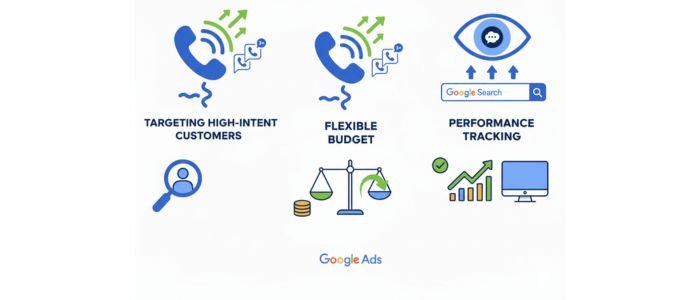
Targeting High-Intent Customers
The biggest benefit of Google Ads is its ability to reach customers with strong intent who are looking for an urgent solution. Google Ads allows companies to target such searches with ad scheduling, location targeting, and precise keywords. This targeted method increases the chances of generating high-quality inbound calls and reduces wasted ad spend. It ensures that the audience who sees your ad is interested in your service, this enhances overall campaign efficiency and conversion rates.
Flexible Budget
Google Ads enable companies to control spending at campaign level and everyday. Home service providers can start with small budgets, test performance, and increase spend when they start seeing results. This flexibility is best for home service providers since demand can fluctuate with market conditions or seasonally.
Performance Tracking
Another key advantage is detailed performance tracking, which allows companies to monitor conversions, clicks, and impressions, also including calls directly generated from ads. Call tracking features allow home service providers to measure duration and quality of calls, which ensures that ad budget is generating real results. Google Ads offers home service providers with a measurable and powerful approach to efficiently manage advertising budget, connect with high-intent customers, and drive inbound calls.
See more on call-focused strategies in “Why Every Home Service Business Needs a Call-Driven Marketing Strategy“.
How to Prevent Google Ads Mistakes that Lowers Call Volume?
Most home service providers make avoidable mistakes when running Google Ads for inbound calls. Focusing on the following areas ensure that every campaign drives real phone leads and reaches the right audience. Avoiding the following common errors can generate more quality calls and enhance campaigns efficiency:
- Ignoring Mobile Users: Most service calls come from mobile devices, so also focus on mobile optimization.
- Targeting Overly Broad Keywords: Wastes ad budget on customers who are not ready to book or contact your company.
- Not Using Call-Only Campaigns or Call Extensions: Missing out on direct dialing opportunities reduces inbound calls.
Conclusion
Companies can directly connect with ready-to-act customers by optimizing ad copy with clear CTAs, using call-focused campaigns, and targeting high-intent customers. Mobile optimization, careful keyword selection, and proper use of ad extensions increase lead quality and call volume. Google Ads provide measurable results that help home service companies to grow by converting online searches into actionable and read phone calls whether managed via lead providers or internally.
Maximize inbound calls and opportunities by opting to buy siding leads online.
FAQs
What is the best way to get more calls from Google Ads for your company?
LSAs (Local Services Ads) and call-only ads are the most effective way to generate inbound calls for any business.
How does Google Ads help home service companies get leads?
It targets customers who are searching for services and connect them with home service providers directly.
What is the difference between pay-per-call and PPC?
The basic difference between pay-per-call is that this strategy charges only for qualified phone leads and PPC (pay-per-click) charges per click.
Do I need a website to run call-focused Google Ads?
No, you don’t need a website to run call-focused Google Ads. LSAs (Local Services Ads) and call-only ads can generate calls without a website.


Leave a Reply